New Cultural Plan Approved as City Weighs Local Expertise vs. Outside Consultants
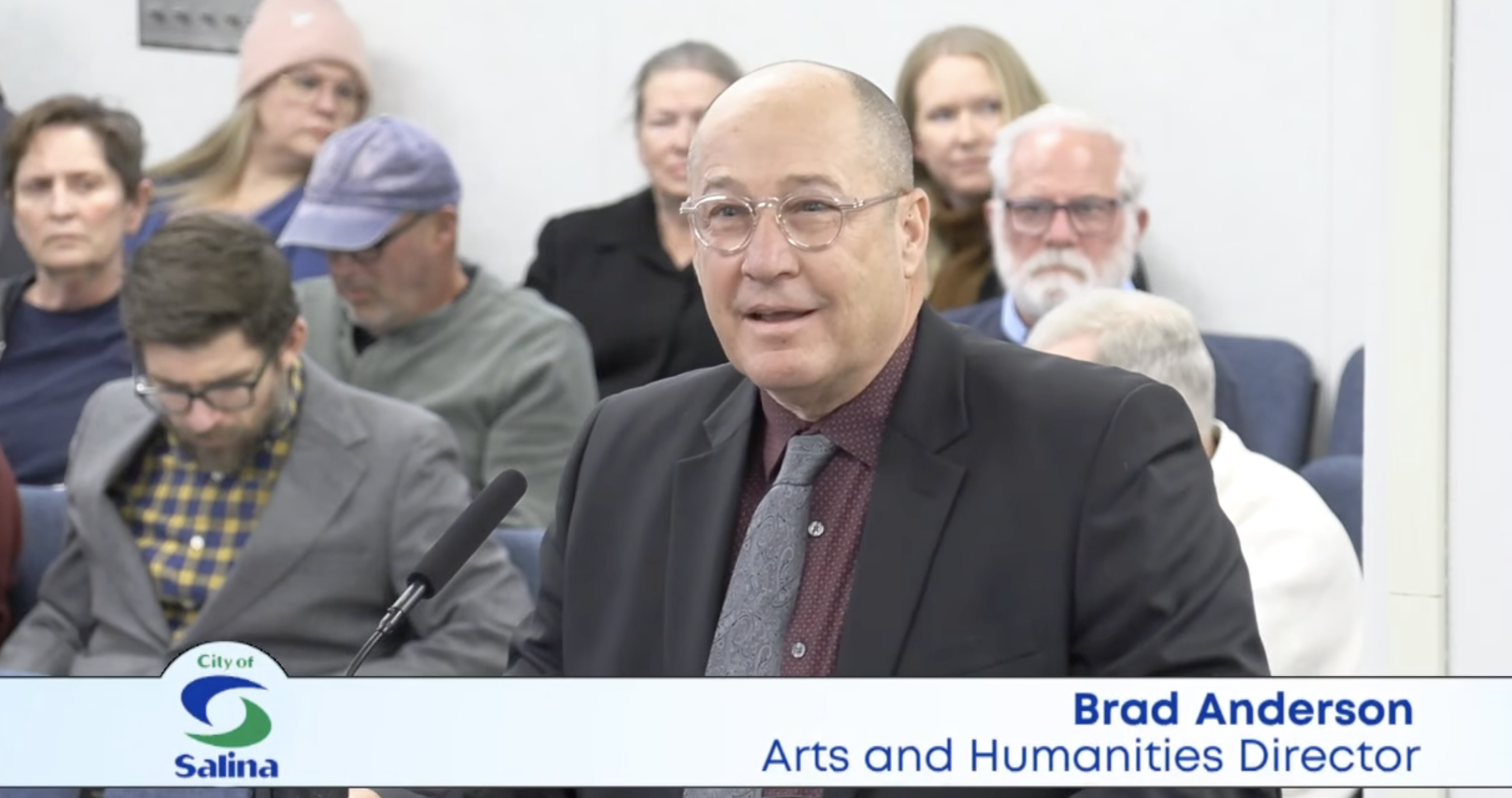
Salina Arts and Humanities Executive Director Brad Anderson asked the Salina City Commission to support a new cultural assessment and strategic plan, citing major demographic, economic, and cultural changes since the city’s last comprehensive cultural plan was adopted in 2009.
Anderson said the request comes after more than a decade and a half of growth, expansion, and shifting community expectations, noting that Salina has completed only two formal cultural plans in its history—one in the early 1990s and the most recent in 2009.
“It’s an exciting time to talk about the future of the community,” Anderson told commissioners, adding that the city’s cultural infrastructure, partnerships, and public engagement look significantly different today than they did when the current plan was written.
To illustrate that change, Anderson referenced language from the opening pages of the 2009 plan, written by the plan’s author before outlining goals or objectives. The document noted a long-held perception in Salina that the arts existed “only for a select segment of the population.” At the time, Anderson said, surveys showed only 52 percent of Salinans believed the arts were important to the community, compared to a 96 percent national average.
On the surface, Anderson acknowledged that figure might appear acceptable, but said it highlighted a major gap between Salina and peer communities nationwide.
“That was a high order,” Anderson said, describing the challenge of shifting public perception and building broader community support for arts and culture.
He reminded commissioners that the period leading up to and following adoption of the 2009 plan was marked by frequent public resistance to arts initiatives, particularly public art. Anderson referenced the difficulty of responding to anonymous criticism and misinformation during that time, describing it as “difficult to box with shadows.”
Despite that resistance, Anderson said the city committed to the planning process, investing approximately $40,000 in 2007 and 2008 for a year-long effort that resulted in four major goals, 17 objectives, and 58 strategies. Many of those strategies, he said, are still in use today and continue to be updated.
One of the earliest objectives of the plan was to expand the reach of arts, culture, and heritage across the community and region. Anderson pointed to the creation of the Cultural Arts Regional Marketing Program, which promotes Salina’s cultural offerings beyond Saline County.
As a result, Anderson said venues such as the Stiefel Theatre now report that roughly 72 percent of ticket sales come from outside Saline County, while Salina Community Theatre and the Salina Symphony also attract a significant share of out-of-county visitors. He said those figures reflect the plan’s emphasis on positioning arts and culture as both a community asset and an economic driver.
Another objective focused on improving public access to information about arts, culture, and heritage. Since 2009, Anderson said, the city has tested multiple communication formats, including print newsletters, e-newsletters, calendars, and regular listings in local media. Those efforts eventually evolved into Salina Arts & Entertainment, which now serves as a centralized platform where cultural organizations can submit events and residents can find programming across disciplines and interests.
Anderson said that centralization has improved accessibility, transparency, and ease of use for residents, while also reducing duplication across organizations.
Public art was another key area addressed by the 2009 plan. Anderson told commissioners that since its adoption, more than 100 new works of public art have been installed in parks, public rights-of-way, and public buildings throughout Salina.
He also described efforts to increase public understanding and acceptance of public art, including the creation of a community awareness guide explaining why art and design matter in public spaces. Approximately 4,000 copies of that guide were distributed through medical offices, waiting rooms, civic venues, direct mail, and public presentations. Additional brochures and presentations followed, with staff regularly speaking to civic clubs and community organizations.
In later years, Anderson said the city updated its public art policy to include guidelines allowing private citizens to propose and install art in public spaces. That change, he said, helped streamline projects such as SculptureTour Salina and private donations of artwork to city parks, including pieces installed at Lakewood Park and the soccer complex.
Beyond public art, Anderson highlighted how the plan supported collaboration between artists, educational institutions, nonprofits, and businesses. Welding programs at Salina Tech and Central High School have contributed to public artworks, while local businesses have underwritten installations at public facilities. He also noted that USD 305 designated $120,000 in its 2014 bond issue to integrate art into school construction projects, with Salina Arts and Humanities helping manage that work.
Anderson cited additional examples of creative infrastructure developed since 2009, including the opening of Theatre Salina’s black box theater, new artist workspace and exhibition opportunities at The Temple, and arts-based education initiatives tied to environmental programming along the Smoky Hill River.
He also said arts and culture have increasingly played a role in economic development and workforce recruitment. Materials produced by Salina Arts and Humanities are routinely shared with human resources directors at manufacturing plants, hospitals, and other employers to help showcase the community to prospective employees. Anderson noted that leaders from incoming companies have cited Salina’s creative environment as a factor in their decision to locate here.
Taken together, Anderson said, those outcomes demonstrate that the 2009 plan has had a measurable and lasting impact—but also that the city has outgrown it.
“We’ve kept this plan alive. We’ve kept it active,” Anderson said. “But it’s time for change.”
He concluded by noting that Salina Arts and Humanities is celebrating its 60th anniversary, the Smoky Hill River Festival its 50th, and the Smoky Hill Museum its 40th, calling the moment an appropriate time to reassess priorities and plan for the future.
Commission, Public Weigh Cost, Use of Consultants Before Approving Cultural Planning Contract 4 to 1
SALINA — Following a presentation from Salina Arts and Humanities Executive Director Brad Anderson, Doug Rempp raised questions about whether an outside consulting firm was necessary to conduct a new cultural assessment and strategic plan.
Rempp said he believed Salina has significant internal talent and long-standing local leadership and questioned whether a similar planning effort could be completed using community members rather than an outside firm. He noted concerns about the city’s frequent use of consultants and cited the size of the Salina Arts and Humanities budget and staff when asking whether the work could be done locally.
Anderson responded that he shared pride in Salina’s local expertise and agreed the community has a strong “brain trust,” but said no local group or individual stepped forward when a formal call for proposals was issued.
He explained that managing a year-long visioning process, conducting broad community engagement, and producing statistically valid research would be difficult to accomplish alongside existing staff workloads. Anderson also said an outside consultant provides a neutral perspective and specialized research capacity that avoids the appearance of self-interest.
Anderson referenced his experience serving on Salina’s first cultural planning committee in the early 1990s, noting that outside consultants helped establish a vision that exceeded what even a large local steering committee could have produced. He emphasized the importance of professional research to ensure the resulting data is credible and defensible.
Other commissioners spoke in support of the proposal, noting that while some consultant-led studies fail to produce lasting results, Salina’s 2009 cultural plan, commonly referred to as “Big Ideas,” has remained an active roadmap for nearly two decades. One commissioner said investing in a planning process every 18 to 20 years was reasonable given the long-term impact of the previous plan.
During public comment, several residents echoed Rempp’s concerns, questioning whether a department with seven employees and a budget exceeding $1 million could absorb the work internally and save taxpayer dollars. Others raised concerns about consistency in the city’s approach to cultural projects.
Additional speakers spoke in favor of the plan, emphasizing the role arts and culture play in economic development, workforce recruitment, and quality of life. Some said Salina’s arts community was a key factor in choosing to live or relocate here.
When asked whether public attitudes toward the arts had been measured since the 2009 plan, Anderson confirmed that a follow-up survey conducted in 2016 asked the same question and found that support for the arts increased from 52 percent to 88 percent. He said the consultant plans to ask that question again to measure continued progress.
Following the discussion, the commission considered a motion to authorize the City Manager to execute a professional services agreement with Keen Independent Research.
The agreement includes a base contract of $49,910 with a $9,991 contingency, for a total not-to-exceed amount of $59,901.
The motion passed on a 4–1 vote, with Commissioner Doug Rempp casting the dissenting vote.
Receive Local Information Like This In Your Inbox
Stay informed with stories and updates from your community